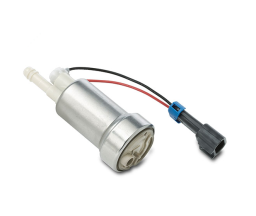
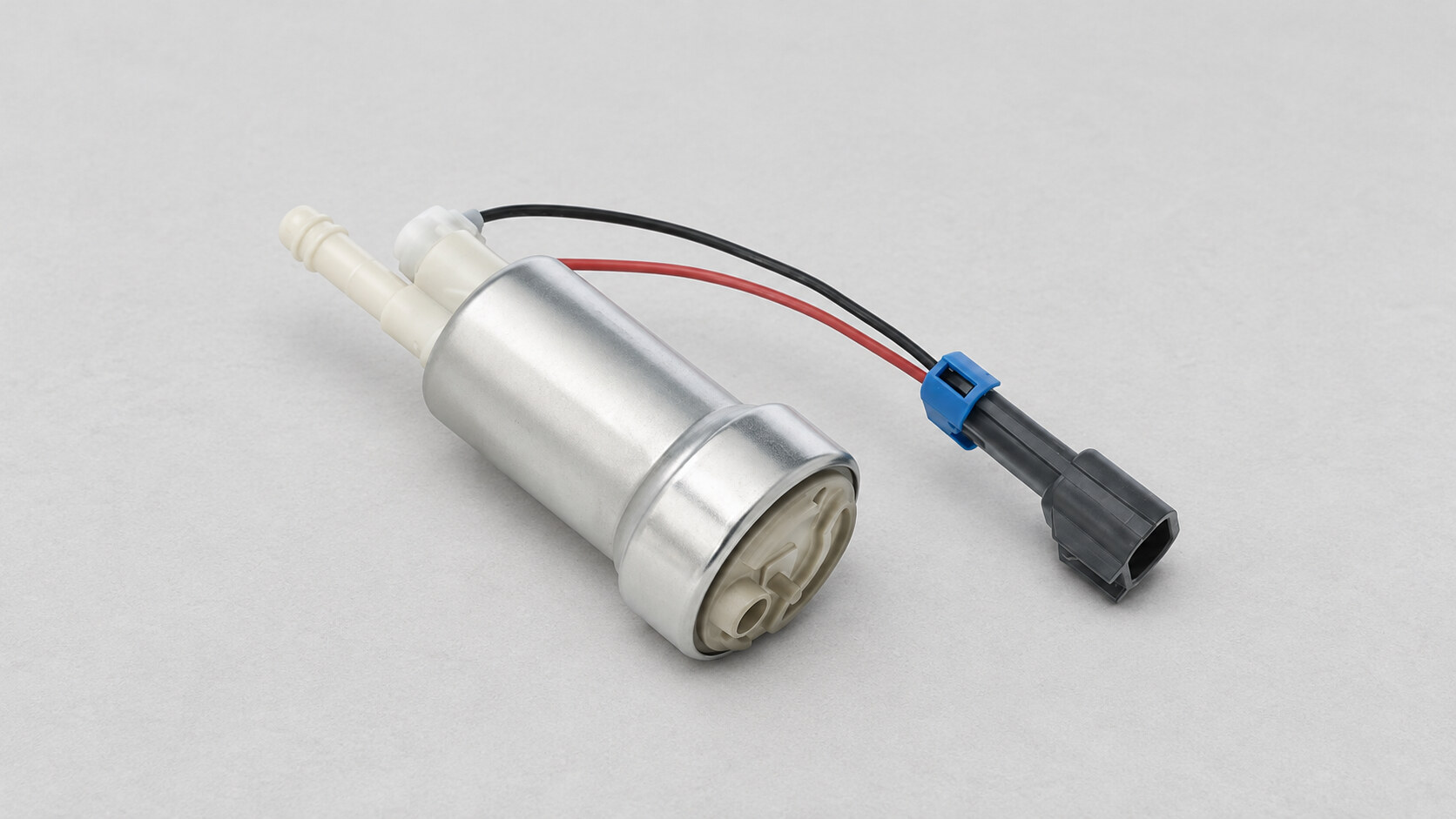
Choosing a Walbro 460, 525 or 535 isn't as simple as picking the biggest number. Those labels don't tell you how much fuel the pump will deliver in your car.
In many turbo fuel systems, increasing boost also raises the fuel pressure the pump has to work against. At that higher pressure, these pumps deliver less fuel and draw more current. If the wiring also loses voltage, even a 535 can supply much less fuel than you expected.
That means choosing the pump and sorting out its wiring go together. A larger pump may be exactly what your build needs, but it needs enough electrical power and a fuel system that lets it do its job.
Why boost changes the amount of fuel a pump can supply
A fuel pump supplies less fuel as the pressure it pushes against increases. So a figure measured at relatively low pressure won't tell you what the same pump can supply at full boost.
Many turbo engines use a fuel-pressure regulator that raises fuel pressure by one psi for every psi of boost. This helps the injectors keep delivering the intended amount of fuel as boost rises.
For example, 43.5 psi base fuel pressure plus 25 psi boost means about 68.5 psi at the fuel rail. The pump also has to overcome resistance through the fuel line, filter and fittings. It is working harder than a 40 psi flow rating might suggest.
Those are example figures, not settings for your engine. Some cars control fuel pressure differently, so establish how yours works before choosing a pump.
Why the wiring matters
The voltage reaching the pump affects how much fuel it can move. Thin wiring, tired connectors, a poor earth or an unsuitable relay can all lose voltage before it reaches the pump.
TI's test figures show what that means. At 80 psi, the 535 supplied about 394 litres per hour at 13.5 V. At the same pressure with 12 V, that fell to about 331 litres per hour. The pump hadn't changed; the voltage had.
So a bigger pump can disappoint if its wiring holds it back. Have the voltage measured at the pump while it's working hard. A good reading at the battery doesn't tell you what's reaching the other end of the wiring.
These pumps also draw more current as pressure rises through the range shown in their test data. The installer should size the wiring, relay or controller, fuse and earth connection for the chosen pump, including its starting requirements. Choosing those parts together is better than hoping the original circuit will cope.
Which Walbro pump makes sense for your build?
Walbro 460: when it already does the job
The 460 is F90000267, also called the Walbro 450 by TI Automotive. If it supplies enough fuel at your required pressure and voltage, with some capacity left over, there is little reason to replace it just for a larger number.
Watch the pressure requirement on higher-boost builds. TI lists a maximum system pressure of 87 psi for this pump, compared with 112 psi for the 525 and 535. Those are limits, not targets or guarantees of enough fuel flow.
Walbro 525: a straightforward step up
The 525, F90000285, offers more delivery at higher pressure and keeps the internal check valve that helps hold fuel pressure after shutdown.
For a street car needing more fuel than the 460 can supply, it is often a straightforward choice. It also draws more current in the comparison below, so include the electrical work when planning the upgrade.
Walbro 535: more flow, with an installation difference
The 535, F90000295, has the highest published flow of these three at the pressures shown below. It is useful when you need that extra delivery, but it has no internal check valve.
That matters when starting the engine and when using more than one pump. Choose it because the extra fuel supply suits the build and the installation can accommodate it, rather than assuming it is the best replacement in every car.
What does the 535's missing check valve mean?
A check valve is a one-way valve. It helps stop fuel flowing backwards through the pump when the pump switches off. Without it, pressure can fall after shutdown, and the system may need more time to build pressure before the engine starts.
It also matters in a two-pump system where the second pump only switches on when needed. Fuel from the running pump must not flow backwards through the stopped one. The hanger or surge-tank arrangement needs to prevent that.
TI's 535 product sheet specifies no internal check valve, although its general web listing has a conflicting field. Confirm the supplied pump's specification if your system relies on that valve. An external valve can be part of an approved installation, but it must handle the fuel and flow without adding excessive restriction.
What the flow figures actually show
The model names are useful shorthand, rather than a promise of fuel delivery. For example, TI's 525 product sheet rates it at 470 L/h at 40 psi and 13.5 V.
The table shows selected results at higher pressure. These are examples; your tuner or installer can check the full pump data for the pressure and voltage in your car. The current column shows why the electrical supply needs attention too.
| Pump | 60 psi, 13.5 V | 80 psi, 13.5 V | 80 psi, 12 V | Current at 80 psi, 13.5 V |
|---|---|---|---|---|
| 460 / F90000267 | 381 L/h | 328 L/h | 273 L/h | 18.68 A |
| 525 / F90000285 | 404 L/h | 361 L/h | 306 L/h | 22.20 A |
| 535 / F90000295 | 444 L/h | 394 L/h | 331 L/h | 21.65 A |
Source tables: F90000267, F90000285 and F90000295. Flow is rounded to whole L/h, with the 285 and 295 figures converted from US gallons per hour.
These are separate TI tests, not a back-to-back E85 comparison. The 267 and 285 used different test fluids; the 295 sheet doesn't identify its fluid. Use the figures to understand the changes with pressure and voltage, rather than expecting exactly these results in your car.
Get the rest of the installation right
If you are replacing a pump because fuel pressure is falling, find out why first. A blocked filter, poor electrical supply or pickup drawing air when the tank is low can all leave the engine short of fuel. A larger pump won't remove those problems.
There is another trap at idle. In a system that returns unused fuel to the tank, the regulator and return line must handle the larger pump's extra flow. If pressure becomes too high and won't adjust down after an upgrade, investigate that return path.
All three models have manufacturer support for E85, but the hoses, seals, filter and other fuel-system parts must suit it too. E85 generally needs more fuel than petrol for comparable power. Have your tuner work out the requirement for your fuel and target power, leaving some spare capacity.
Check the pump's fit in the hanger, including its length, inlet, strainer and electrical connection. After fitting, have the fuel pressure checked under load. Suitable fuel injectors with consistent flow and response are another part of getting the combination right.
Spool supplies the 460 kit, EFP-287, 525 kit, EFP-530 and 535 kit, EFP-622. Tell us your fuel, target power, base pressure, boost and existing pump arrangement when asking about a kit. Include whether the power figure is at the engine or wheels, and the voltage reaching the pump if known.
Frequently asked questions
Can I run a Walbro 535 on the original wiring?
Only if the circuit can safely support the pump and deliver enough voltage under load. Have the wiring, connectors, relay or controller, fuse and earth checked rather than assuming they suit the larger pump.
Is the Walbro 525 or 535 better for a street car?
The 525 is often simpler if it supplies enough fuel, because it includes a check valve. The 535 offers more published flow, but the installation needs to account for its missing check valve.
Why is the Walbro 460 also called a 450?
Both names are used for F90000267. Spool's kit is listed as the 460, while TI Automotive calls the pump a Walbro 450. Compare the part number and flow data when ordering.
How much power can one pump support on E85?
That depends on the engine's fuel requirement and how much the pump supplies at the pressure and voltage in the car. A petrol horsepower claim does not establish its capacity on E85.