
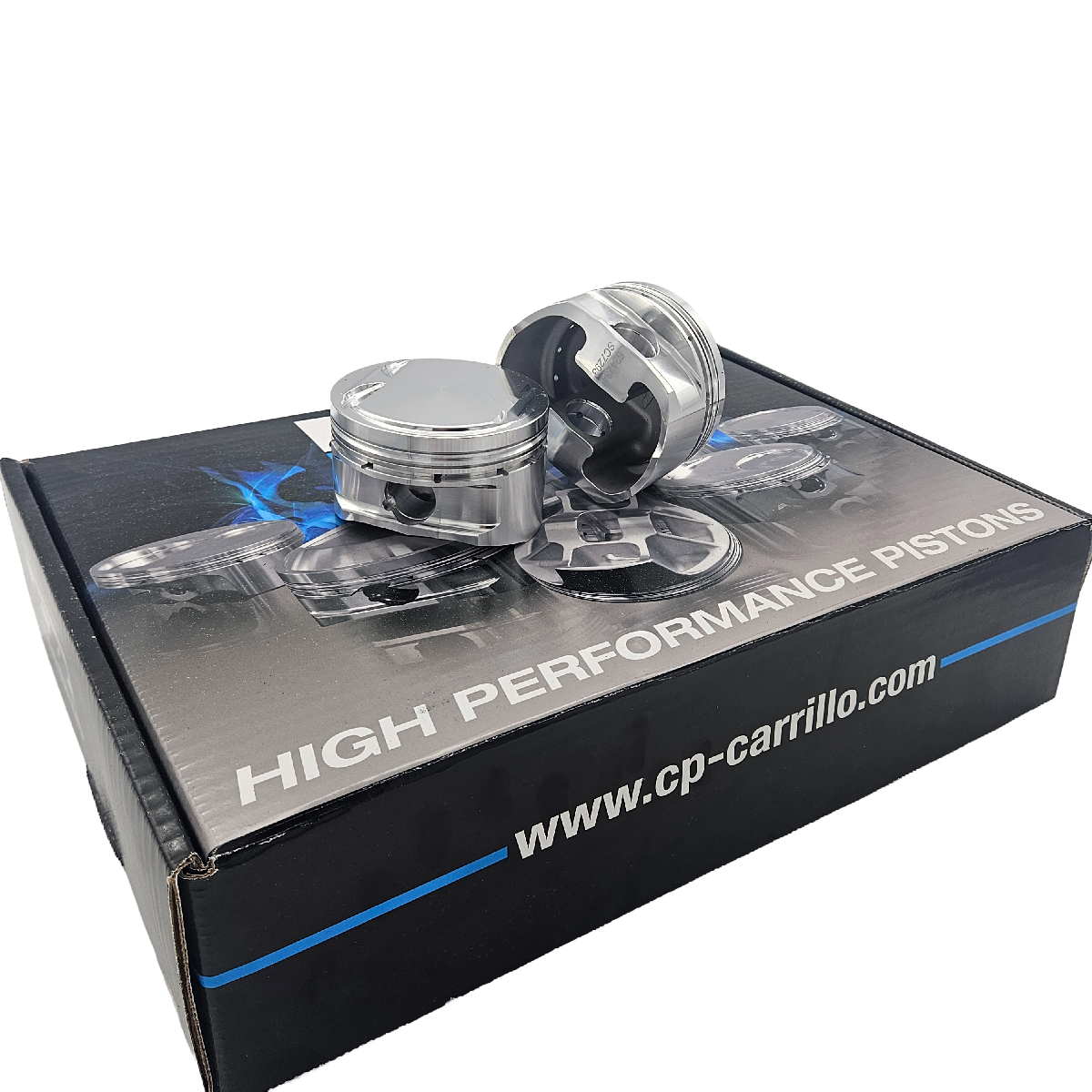
Before ordering forged pistons, settle the crank stroke, conrod length and finished block height with your engine builder. Bore size and a quoted compression ratio will narrow the choices, but they will not tell you whether the piston reaches the right position at the top of the cylinder.
That is where compression height matters. Get it wrong and the piston can sit too far down the bore or project above the block deck. Sorting that out after the pistons arrive can mean changing parts or revisiting the machining plan. It is much easier to choose the piston around the measured combination from the start.
What compression height actually measures
Compression height is the distance from the centre of the gudgeon pin to the piston's deck reference surface. Think of the flat crown reference, rather than the top of a raised dome or the bottom of a dish. CP's piston specification drawing labels this dimension as centre of pin to deck.
The conrod attaches to that pin. With the crank at top dead centre, the crank's half-stroke, the rod's centre-to-centre length and the piston's compression height determine how high that reference surface sits.
Block deck height is a separate measurement: the distance from the crankshaft centreline to the block's head-gasket surface. Piston-to-deck clearance is the remaining distance between that surface and the piston's deck reference at top dead centre.
Why a stroker needs a matched piston
Increasing crank stroke moves the piston further upwards and downwards. If the rod length stays the same, a shorter compression height brings the piston back towards the intended deck position. A longer rod also needs a corresponding change elsewhere in the combination.
Two CP Bullet LS catalogue entries show the relationship:
- BLS1001-007: 3.905-inch bore, 3.622-inch stroke, 6.125-inch rod and 1.300-inch compression height.
- BLS1002-007: 3.905-inch bore, 4.000-inch stroke, 6.125-inch rod and 1.110-inch compression height.
The bore and rod length are the same, but the longer-stroke combination uses a substantially shorter piston compression height. These are specific catalogue combinations, not a claim that both produce exactly the same deck clearance in every block.
If you are choosing between those rebuild routes, our LS1 standard-stroke and stroker guide explains the wider parts decision. The important point here is to choose the crank, rods and pistons together.
How to calculate the required compression height
For the basic geometry, use:
Compression height = block deck height − half the crank stroke − conrod length − piston-to-deck clearance.
In this formula, use a positive deck-clearance number when the piston sits below the deck. Use a negative number when it projects above it. Zero means the reference surface is level with the block deck. Keep all dimensions in the same units.
As a hypothetical example, take a 220.00 mm block deck height, an 86.00 mm stroke and a 143.00 mm rod. If the planned piston position is 0.20 mm below the deck:
220.00 − 43.00 − 143.00 − 0.20 = 33.80 mm compression height.
Those numbers illustrate the calculation only. They are not a piston specification or recommended clearance for a particular engine. Leaving the deck-clearance term out would calculate a zero-deck combination instead.
The calculation helps select parts. Trial assembly then checks the result with the actual components, using a dial indicator and a suitable deck bridge or fixture. Piston rock affects readings, so the builder needs a consistent measuring method rather than taking whichever crown-edge reading looks best.
What happens when the block has been decked?
Machining the block's deck reduces its height. With the same crank, rods and pistons, that leaves the piston closer to the deck surface, or further above it if it already protruded.
A used block may have been machined before you bought it. Ordering from the factory nominal height can therefore give the wrong result even when all the new parts match their catalogue descriptions.
Have the machine shop establish the block's condition and agree the intended finished deck height before committing to the piston specification. Check each cylinder during trial assembly: machining and component differences can leave different piston positions across the engine.
Compression height and compression ratio are different
Compression height is a physical dimension. Compression ratio describes the relationship between the cylinder's total volume at bottom dead centre and the volume remaining at top dead centre.
Piston position affects that remaining volume, but so do the combustion chamber, piston dish or dome, valve reliefs and head-gasket dimensions. Two pistons with the same compression height can have different crown shapes and produce different compression ratios.
A catalogue compression-ratio figure belongs to the manufacturer's stated combination. Use your actual chamber volume, gasket and deck position when calculating the finished engine's ratio.
Deck clearance does not settle every clearance
Piston-to-head clearance includes the space created by the compressed head gasket. At matching flat piston and head surfaces, a piston below deck has that deck clearance plus the compressed gasket thickness. Protrusion reduces the available space.
The builder must assess the actual crown and chamber shapes and allow for how the engine behaves in service. A thicker gasket changes both this clearance and compression ratio; choosing one purely to rescue the wrong piston can create a different compromise.
Piston-to-valve clearance needs its own check through the relevant crank positions with the intended cam timing. Valve angle, pocket position, pocket depth and valve movement all matter. A satisfactory piston-to-head measurement does not prove the valves will clear.
What to have ready before ordering
A useful piston enquiry starts with the measured build details:
- Exact engine and block, including known previous machining.
- Planned finished bore and block deck height.
- Crank stroke, conrod centre-to-centre length and gudgeon-pin diameter.
- Required piston-to-deck position, clearly stated as below or above deck.
- Cylinder heads, chamber volume, gasket bore and compressed thickness.
- Camshaft and valve details, intended fuel, use and target compression ratio.
Include part numbers for components you already own. Spool supplies CP-Carrillo pistons and conrods in Australia, and those details make it easier to identify the appropriate catalogue combination. For an LS build, the LS Piston Finder is a useful starting point once the stroke and rod choice are settled.
Some combinations need a purpose-designed piston rather than the nearest catalogue size. Spool's custom CP RB32 stroker pistons are one application-specific example. Their dimensions belong to that combination; the useful question is whether an existing piston matches your measured build, or whether a custom specification is needed.
Frequently asked questions
Can I order pistons using bore size alone?
No. You also need to match the stroke, rod length, pin dimensions, compression height and cylinder-head requirements. Bore size establishes only part of the fit.
Does a shorter compression height mean a lower compression ratio?
Not necessarily. Compression ratio also depends on piston crown volume, chamber volume, gasket dimensions and the assembled deck position. A shorter piston may be designed for a longer stroke or rod.
Does zero deck mean the piston touches the head?
No. Zero deck means the piston's deck reference is level with the block deck at top dead centre. The compressed gasket and actual crown and chamber shapes still affect piston-to-head clearance.
Can I assume an old block still has its factory deck height?
No. Previous machining may have reduced it. Have the block measured and agree the finished deck height before choosing pistons around a nominal factory dimension.

