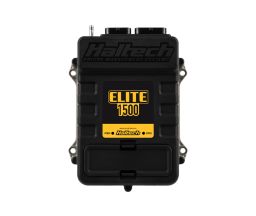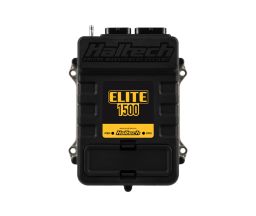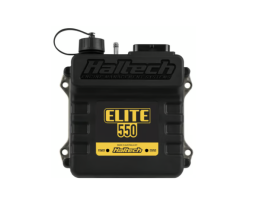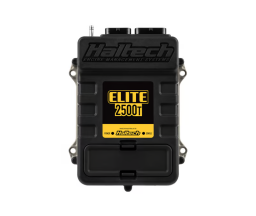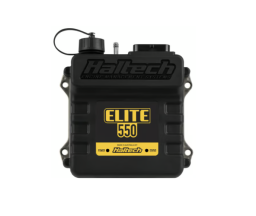

Haltech has announced the end of production for most of its Elite wire-in ECU range following the release of the new Nexus T1 and Nexus T2. The new T-Series ECUs directly replace the Elite 550 and Elite 750, retaining the familiar single-connector format while introducing current Nexus software, wireless connectivity, more advanced engine protection and a considerably broader range of motorsport functions.
The announcement also covers the Elite 1500, Elite 2500 and Elite 2500 T. However, the Nexus T1 and T2 are not direct replacements for these higher-specification ECUs. Applications requiring drive-by-wire throttle control, additional injector and ignition outputs, dual knock inputs or more extensive input and output capacity will need to be matched to another ECU in the Nexus range.
The important point: the Elite ECUs are reaching the end of production, but existing Elite installations are not becoming unsupported. Haltech has confirmed that repair services will continue and that Elite harnesses and patch adaptor harnesses will remain available until at least the end of 2026.
Which Haltech Elite ECUs are being discontinued?
Haltech’s August 2026 end-of-life notice lists the following wire-in ECUs:
| Part number | Elite ECU | Replacement position |
|---|---|---|
| HT-150400 | Elite 550 | Nexus T1 is the direct successor |
| HT-150600 | Elite 750 | Nexus T2 is the direct successor |
| HT-150900 | Elite 1500 | Select a Nexus ECU according to the engine and required functions |
| HT-151300 | Elite 2500 | Select a Nexus ECU according to the required I/O, DBW and control strategy |
| HT-151310 | Elite 2500 T | Select a suitable Nexus ECU and transmission-control solution for the application |
Production will not continue after Haltech’s remaining stock is exhausted. Availability of an Elite ECU will therefore depend on stock held by Haltech and its dealer network.
One notable exception is the HT-154000 Elite PRO Plug-in ECU for the Ford Falcon Barra inline-six. Haltech has specifically confirmed that this model is not being discontinued and will continue to be produced and sold.
What replaces the Elite 550 and Elite 750?
The Haltech Nexus T1 replaces the Elite 550, while the Nexus T2 replaces the Elite 750.
- Nexus T1 – HT-210000: four injector and four ignition outputs, making it the natural choice for sequential control of engines with up to four cylinders or two rotors.
- Nexus T2 – HT-211000: six injector and six ignition outputs, allowing sequential control of engines with up to six cylinders or three rotors.
Both ECUs can control engines with up to 12 cylinders when batch-fire or semi-sequential injection and suitable ignition arrangements are used. That does not mean every engine up to 12 cylinders is automatically a good T-Series application. The number of outputs, sensors, camshafts, auxiliary devices and control functions required must still be checked before choosing an ECU.
Will an Elite 550 or 750 harness work with a Nexus T1 or T2?
Yes. Haltech has retained the same connector and pinout used by the Elite 550 and Elite 750, allowing existing universal harnesses, terminated harnesses and patch adaptor harnesses developed for those ECUs to be used with the corresponding Nexus T-Series ECU.
The main pin-function change is pin 13. On the Nexus T1 and T2, it can operate as either the second synchronised pulsed input or the ECU’s knock input. The Elite 550 and 750 used this position as SPI 2 and did not offer onboard knock control.
Connector compatibility does not remove the need to check the wiring and ECU configuration before powering the system. The installer or tuner should confirm every pin assignment, sensor calibration, output function and engine-protection setting for the individual vehicle.
How does the Nexus T-Series improve on the Elite 550 and 750?
The Nexus T1 and T2 are more than repackaged Elite ECUs. They use Haltech’s Nexus Software Programmer and add substantially more processing, logging, protection and motorsport capability.
| Feature | Elite 550/750 | Nexus T1/T2 |
|---|---|---|
| Tuning connection | USB-B cable | High-speed USB-C or wireless Wi-Fi tuning |
| Haltech Connect app | No | Yes |
| Onboard logging storage | 2MB | 32MB |
| Engine protection | Single-level strategies | Multi-level protection with up to three severity levels per condition |
| Knock control | No | Single physical knock input with overall or per-cylinder control |
| Main fuel and ignition tables | 32 × 32, 3D | 32 × 32 × 8, 4D |
| Long-term learning | Up to 3D | Up to 4D |
| Variable cam control | One channel | Up to two channels |
| Nitrous control | One stage | Up to six stages |
| Traction control | No | Yes |
| Trans-brake control | No | Yes |
| CO2 boost control | No | Yes |
| Oscilloscope | Four-channel with limited measurements | Four-channel general-purpose oscilloscope with voltage measurement |
Multi-level engine protection
One of the most useful upgrades is multi-level engine protection. Rather than relying on a single response when a limit is exceeded, the tuner can configure graduated intervention according to the severity of the condition.
Depending on the calibration, the ECU can respond with ignition retard, reduced boost, additional fuel or a lower rev limit. This can allow a warning or mild intervention for an initial abnormal condition before applying stronger protection if the problem becomes more serious.
Engine protection is only as effective as the sensors, wiring and calibration behind it. Appropriate oil pressure, fuel pressure, coolant temperature and other relevant sensors must be installed and configured correctly. The protection thresholds also need to reflect the engine, oil viscosity, operating conditions and intended use.
Wireless tuning and the Haltech Connect app
The Nexus T1 and T2 can be tuned wirelessly through NSP over Wi-Fi, removing the need to keep a USB cable connected during normal tuning work. A USB-C connection remains available for high-speed communication, firmware updates and diagnostics.
The Haltech Connect app provides wireless access to real-time data, basic gauges, diagnostic trouble-code clearing, wiring assignments and selected parameter adjustments from a compatible phone.
This does not replace a properly configured dash or laptop for detailed tuning and analysis, but it can make workshop diagnostics and quick trackside checks considerably more convenient.
Important T1 and T2 limitations
The “Nexus” name does not mean the T1 and T2 include every function found in higher models such as the Nexus S3, R3 or R5. The T-Series is intended as the entry point into Haltech’s standalone ECU range.
In particular:
- The T1 and T2 support cable-operated throttle and do not provide onboard drive-by-wire throttle control.
- They provide one CAN network rather than the broader communications and power-management capacity of higher Nexus models.
- They do not contain an onboard wideband oxygen controller. Closed-loop wideband control requires a compatible external CAN wideband controller such as a Haltech WB1 or WB2.
- They are ECUs, not integrated power-distribution modules.
- There is one physical knock input, although the ECU can apply overall or per-cylinder knock-control strategies.
- Five digital pulsed outputs must cover auxiliary functions such as boost control, idle control, fuel pumps, fans and other devices required by the installation.
Before choosing either ECU, prepare an input-and-output list for the complete vehicle. Allow for future additions where practical; changing ECUs later is usually more expensive than selecting sufficient capacity at the beginning.
Does the Nexus T-Series replace the Elite 1500 or Elite 2500?
Not directly. The T1 and T2 replace the Elite 550 and Elite 750 in Haltech’s range, but they do not reproduce all the capabilities of the Elite 1500, Elite 2500 or Elite 2500 T.
An Elite 1500 or 2500 application may require drive-by-wire control, eight sequential injector and ignition channels, staged injection, additional cam control, more analogue and speed inputs, dual knock inputs or considerably more auxiliary outputs. Depending on those requirements, a Nexus S-Series or R-Series ECU may be the more appropriate replacement.
The correct ECU should be selected from the vehicle’s actual control requirements rather than simply choosing the model closest in price. Spool Imports can help compare the available Haltech ECU and engine-management options for a new installation.
What happens to existing Elite ECU owners?
There is no need to replace a working Elite ECU simply because the range has reached the end of production. Haltech has confirmed that repair services will continue well into the future, while Elite harnesses and patch adaptors will continue to be manufactured until at least the end of 2026.
For vehicles already running reliably on an Elite ECU, the sensible approach is generally to retain it unless the build requires functions that the existing ECU cannot provide. Keep a current copy of the tune, document the wiring and ensure that any unusual connectors or harness components can be serviced if the vehicle is expected to remain in use for many years.
Should you still buy an Elite ECU?
An Elite ECU may still make sense for an existing installation that requires a direct replacement, particularly where the vehicle already has an Elite-specific harness and tune. Remaining stock may also be useful for matching a fleet, race program or workshop package that has been standardised around a particular Elite model.
For most new builds, however, the current Nexus platform will be the better starting point. The newer software environment, larger onboard logging capacity, wireless access and improved protection strategies provide a stronger foundation for future tuning and development.
Frequently asked questions
Has Haltech discontinued every Elite ECU?
No. Haltech is ending production of the Elite 550, Elite 750, Elite 1500, Elite 2500 and Elite 2500 T wire-in ECUs. The HT-154000 Elite PRO Plug-in ECU for the Ford Falcon Barra inline-six is not end-of-life and will continue to be produced.
What ECU replaces the Haltech Elite 550?
The Haltech Nexus T1 is the direct successor to the Elite 550. It retains the same connector and pinout while adding Wi-Fi tuning, knock control, multi-level engine protection, 32MB onboard logging and more advanced motorsport functions.
What ECU replaces the Haltech Elite 750?
The Haltech Nexus T2 is the direct successor to the Elite 750. It has six injector and six ignition outputs and is intended for applications including sequentially controlled six-cylinder and three-rotor engines.
Can a Nexus T1 or T2 plug into an existing Elite harness?
Yes, the Nexus T1 and T2 use the same connector and pinout as the Elite 550 and Elite 750. However, the installer must verify the complete wiring and configuration, particularly pin 13, which can now be used as a knock input or SPI 2.
Does the Nexus T2 have drive-by-wire throttle control?
No. Both the Nexus T1 and Nexus T2 are designed for cable-operated throttle applications. A build requiring electronic throttle control will need a suitable higher-specification Haltech Nexus ECU.
Does the Nexus T1 or T2 have a built-in wideband controller?
No. The Nexus T1 and T2 can perform closed-loop oxygen control, but they require a separate compatible CAN wideband controller such as a Haltech WB1 or WB2.
Can a Nexus T1 or T2 run a V8 engine?
Yes, a Nexus T1 or T2 can control engines with up to 12 cylinders using batch-fire or semi-sequential strategies. For sequential fuel and direct ignition control on a V8, or where more inputs and outputs are required, a higher-capacity Nexus ECU will generally be more appropriate.
Will Haltech continue repairing Elite ECUs?
Yes. Haltech has stated that repair services for the Elite range will continue well into the future. Elite harnesses and patch adaptor harnesses will also continue to be produced until at least the end of 2026.