Main Bearing Clearance vs Rod Bearing Clearance Explained
Main Bearing Clearance vs Rod Bearing Clearance Explained
When you are building a performance engine, bearing clearance is one of those measurements that can make or break the whole job. You can have the right rods, the right pistons, the right crank, the right oil pump and the right tune, but if the bearing clearances are wrong, the engine is already on borrowed time.
Two of the most important measurements are main bearing clearance and rod bearing clearance. They are related, but they are not the same thing. Main bearing clearance controls how the crankshaft is supported in the block. Rod bearing clearance controls how each connecting rod rides on the crank journal. Both affect oil pressure, oil film strength, crankshaft stability, heat control and long-term reliability.
This guide explains the difference between main bearing clearance and rod bearing clearance, why they matter, what happens when they are too tight or too loose, and what you should think about when setting up a street, track or high-boost engine.
What Is Bearing Clearance?
Bearing clearance is the small gap between the crankshaft journal and the bearing shell once everything is assembled and torqued correctly.
That gap is filled with pressurised engine oil. When the engine is running, the crankshaft does not simply rub directly on the bearing surface. Instead, it rides on a thin film of oil. This is called hydrodynamic lubrication.
That oil film has to be thick enough to stop metal-to-metal contact, but not so excessive that the engine loses oil pressure or control of the crankshaft.
In simple terms:
- Too tight: not enough oil film, more heat, higher risk of bearing seizure or material transfer.
- Too loose: reduced oil pressure, less crank control, more noise, more oil leakage from the bearing area.
- Correct clearance: stable oil film, good oil pressure, controlled crankshaft movement and improved reliability.
Main Bearing Clearance vs Rod Bearing Clearance: The Basic Difference
| Clearance Type | Where It Is Measured | Main Job | Why It Matters |
|---|---|---|---|
| Main Bearing Clearance | Between the crankshaft main journals and the main bearing shells in the block | Supports and locates the crankshaft in the engine block | Affects crankshaft stability, oil pressure, block alignment and overall bottom-end durability |
| Rod Bearing Clearance | Between the crankshaft rod journals and the connecting rod bearing shells | Supports the connecting rod on the crankshaft journal | Affects rod journal oil film, big-end bearing life, high RPM durability and cylinder load handling |
The main bearings carry the crankshaft in the block. The rod bearings carry the connecting rods on the crankshaft. Both are part of the same oiling system, but they see different loads and behave differently inside the engine.
What Main Bearings Do
The main bearings support the crankshaft along its centreline. They keep the crankshaft located in the block and control how it rotates under load.
Every time a cylinder fires, the crankshaft is pushed, twisted and flexed. The main bearings absorb and control those loads. In a high-performance engine, especially a turbocharged or high-RPM engine, the main bearings are dealing with enormous cylinder pressure and crankshaft deflection.
Main bearing clearance affects:
- crankshaft stability
- oil pressure
- oil volume through the bottom end
- crankshaft flex control
- main journal temperature
- bearing life
- block and tunnel alignment sensitivity
What Rod Bearings Do
The rod bearings sit between the connecting rods and the crankshaft rod journals. Their job is to let the rod rotate smoothly around the crank journal while handling the force created by combustion and piston movement.
Rod bearings live a hard life. They are loaded heavily during combustion, pulled during exhaust and intake stroke transitions, and constantly exposed to changing direction and inertia loads. In a boosted engine, rod bearing load increases dramatically because cylinder pressure is much higher than standard.
Rod bearing clearance affects:
- big-end bearing oil film strength
- rod journal temperature
- high RPM durability
- oil pressure bleed-off
- bearing crush and seating behaviour
- resistance to bearing wipe under load
Why Main and Rod Bearing Clearances Are Not Always the Same
A common mistake is assuming that main bearing clearance and rod bearing clearance should always be identical. They can be close, but they do not always need to be exactly the same.
Main bearings are supporting the crankshaft in the block. Rod bearings are dealing with the connecting rod load on each crank pin. The load direction, oil supply path, journal diameter, housing bore rigidity and operating conditions are different.
In many performance engines, rod bearing clearance may be set slightly differently to main clearance depending on:
- engine type
- journal diameter
- oil viscosity
- RPM range
- boost pressure
- intended use
- bearing material
- crankshaft material
- rod design
- oil pump capacity
Typical Bearing Clearance Guidelines
There is no single clearance that suits every engine. Always check the engine builder’s specifications, bearing manufacturer’s guidance and the intended use of the engine.
That said, many performance engine builders use a general rule of thumb based around journal diameter.
| Application | Typical Main Bearing Clearance | Typical Rod Bearing Clearance | General Notes |
|---|---|---|---|
| Standard street rebuild | Often tighter, close to factory specification | Often tighter, close to factory specification | Designed for quiet operation, stable oil pressure and normal oil viscosity |
| Performance street engine | Slightly more clearance than a stock rebuild may be used | Slightly more clearance than a stock rebuild may be used | Useful where heat, RPM and load are higher than standard |
| High-boost turbo engine | Often set with more oil film margin | Often set with more oil film margin | Needs enough clearance for oil film strength under high cylinder pressure |
| Drag or race engine | May use looser clearances depending on oil, RPM and bearing strategy | May use looser clearances depending on oil, RPM and bearing strategy | Usually matched with oil viscosity, oil pump capacity and operating temperature |
As a very broad performance-engine rule, many builders start thinking around approximately 0.001 inch of clearance per inch of journal diameter, then adjust from there based on the actual engine, oil, use case and bearing package. This is only a starting point, not a universal specification.
What Happens If Bearing Clearance Is Too Tight?
Tight bearing clearance is not always bad. A factory engine designed for quiet operation, thin oil and normal use may run relatively tight clearances. Problems start when the clearance is too tight for the engine’s power, heat, RPM or oil viscosity.
If main or rod bearing clearance is too tight, the oil film may not be thick enough to separate the crank journal from the bearing surface under load.
Symptoms and risks of tight bearing clearance
- excessive bearing temperature
- bearing material transfer
- scuffed or wiped bearings
- hard crank rotation during assembly
- reduced oil flow through the bearing
- possible bearing seizure
- higher sensitivity to debris or minor misalignment
In a performance engine, tight clearance can become a serious problem when oil temperature rises, the crank flexes, the block moves, or cylinder pressure increases. A clearance that looks acceptable in a cold workshop may not survive repeated high-load pulls if the oil film is not sufficient.
What Happens If Bearing Clearance Is Too Loose?
Loose clearance gives the oil more room to escape from the bearing area. This can increase oil flow through the bearing, but it can also reduce oil pressure and reduce control of the crankshaft or rod journal.
Symptoms and risks of loose bearing clearance
- lower hot idle oil pressure
- increased bearing noise
- reduced crankshaft control
- excessive oil leakage from the bearing
- greater load on the oil pump
- possible oil starvation elsewhere in the engine
- hammering effect on the bearing under load
Loose clearances can work in some race engines, but only when the full oiling system is designed around them. That usually means the correct oil viscosity, oil pump capacity, sump control and operating temperature range.
Oil Pressure vs Oil Flow
One of the biggest misunderstandings around bearing clearance is the relationship between oil pressure and oil flow.
Oil pressure is resistance to flow. Oil flow is the amount of oil actually moving through the engine. Bearing clearance affects both.
- Tighter clearances usually increase oil pressure but may reduce oil flow through the bearing.
- Looser clearances usually increase oil leakage at the bearing and can reduce oil pressure.
- The goal is not simply the highest oil pressure possible. The goal is stable oil pressure with enough oil flow and enough oil film strength.
This is why copying someone else’s bearing clearance without understanding their oil, pump, temperature and engine use can be risky.
Oil Viscosity and Bearing Clearance
Oil viscosity must be matched to bearing clearance. A thin oil in an engine with loose clearances may struggle to maintain hot oil pressure. A thick oil in an engine with tight clearances may not flow properly when cold and can create excessive pressure without improving bearing protection.
| Clearance Setup | Oil Consideration | Risk If Mismatched |
|---|---|---|
| Tighter clearances | Often suited to lighter oil, depending on engine design | Thick oil may reduce cold flow and increase stress on the oiling system |
| Moderate performance clearances | Oil choice depends on temperature, use and engine type | Wrong viscosity can cause pressure instability or insufficient oil film |
| Looser race-style clearances | Often requires more oil viscosity and oil pump capacity | Thin oil may result in low hot oil pressure and reduced bearing protection |
For a street engine, cold start behaviour matters. For a drag engine, oil temperature and short-duration high-load operation matter. For a circuit engine, sustained oil temperature and oil control matter. The bearing clearance should suit the full operating environment, not just the dyno sheet.
Why Boosted Engines Need Extra Attention
Turbocharged and supercharged engines place much higher loads on the bearings than naturally aspirated engines. More boost usually means more cylinder pressure. More cylinder pressure means more force pushing down on the piston, rod and crankshaft.
That extra load increases the demand on the oil film. If the oil film breaks down, the bearing surface can be damaged very quickly.
In a boosted engine, bearing clearance decisions should take into account:
- boost pressure
- fuel type
- engine RPM
- piston and rod weight
- crankshaft material
- oil temperature
- oil pump capacity
- sump and oil control
- intended use of the engine
A mild turbo street engine and a 1200 horsepower drag engine should not automatically be built with the same bearing strategy.
Main Bearing Clearance in Detail
Main bearing clearance is especially important because it affects the crankshaft’s position and stability in the block. If the main clearances are inconsistent, the crankshaft may not be properly supported.
This can be caused by:
- incorrect tunnel alignment
- main cap movement
- line bore or line hone issues
- crankshaft journal size variation
- bearing shell thickness variation
- incorrect fastener torque
- dirty or damaged housing surfaces
When checking main bearing clearance, it is important that the block is clean, the bearings are seated correctly, the caps are installed in the correct position and orientation, and all fasteners are torqued using the intended hardware and lubricant.
Rod Bearing Clearance in Detail
Rod bearing clearance is affected by the crank rod journal size, bearing shell thickness, rod big-end housing bore size and the fasteners used in the rod.
This is particularly important with aftermarket performance rods. Changing rod bolts, bolt lubricant or torque/stretch procedure can affect the big-end housing bore. That can then affect bearing clearance.
For example, if a rod is honed with one bolt type and then assembled with another bolt type or different fastener procedure, the final housing bore may not be exactly the same. That is one reason proper measurement matters.
With Spool H-Beam, Drag Pro and X300 conrods, the same principle applies as any quality performance rod: the final clearance should be checked during the engine build rather than assumed.
How Bearing Clearance Is Measured
The most accurate method is to measure the crankshaft journals and the assembled bearing housing using precision measuring tools.
Common measuring tools
- outside micrometer
- dial bore gauge
- torque wrench
- rod bolt stretch gauge where applicable
- clean assembly bench
The general process is:
- Measure the crankshaft journal diameter with a micrometer.
- Install the bearing shells into the block or rod.
- Torque the main caps or rod bolts using the correct procedure.
- Measure the inside diameter of the installed bearing with a dial bore gauge.
- Subtract the crank journal diameter from the bearing inside diameter.
- The result is the bearing clearance.
Plastigage can be useful as a quick check, but for a proper performance engine build, micrometers and bore gauges are the better method.
Common Bearing Clearance Mistakes
1. Assuming new parts are automatically correct
New does not mean measured. Crankshafts, bearings, rods and blocks all have manufacturing tolerances. Stack those tolerances together and the final clearance may not be what you expected.
2. Measuring with dirty parts
A tiny piece of debris behind a bearing shell can change the reading and create a high spot. Everything needs to be properly cleaned before measuring.
3. Mixing up bearing shells
Bearings must be kept organised. If you swap shells between journals after measuring, your recorded clearances may no longer be accurate.
4. Ignoring housing bore size
Bearing clearance is not only about the crank journal. The block tunnel and rod big-end housing bore matter as well.
5. Using the wrong torque procedure
Main studs, main bolts, rod bolts and upgraded fasteners can all affect housing distortion. Measure the engine using the same fasteners, lubricant and torque or stretch method that will be used in final assembly.
6. Choosing oil after the engine is built
Oil viscosity should be part of the bearing clearance strategy. It should not be an afterthought.
Performance Engine Examples
Ford Barra
The Ford Barra is a strong platform, but high-boost Barra builds need careful attention to bearing clearance, oil pump condition, crankshaft support and fastener choice. As power increases, oil control and bottom-end setup become much more important.
For Barra builds using forged rods, forged pistons, upgraded head studs and high boost, bearing clearance should be measured properly and matched to the oiling system and use case.
Toyota JZ
The 1JZ and 2JZ engines are famous for strength, but they still rely on correct oil clearance. High-RPM and high-boost JZ builds can punish rod bearings if the oil film is not maintained.
Good bearing setup, crank condition, oil control and correct fastener procedure are all part of making a reliable JZ bottom end.
Nissan RB
RB engines, especially RB25, RB26 and RB30 combinations, are sensitive to oiling system condition and high-RPM oil control. Bearing clearance is only one part of the package, but it is a critical one.
For serious RB builds, bearing clearance should be considered alongside oil pump choice, crank collar setup, sump control and intended RPM range.
GM LS
LS engines are popular for street, drag and circuit builds. As with any platform, the right clearance depends on crank condition, bearing choice, oil viscosity, RPM and power level.
A mild street LS and a boosted drag LS should not automatically use the same clearance strategy.
ACL Race Series HX Bearings and Extra Clearance Bearings
In some performance engine builds, the standard bearing clearance may end up tighter than ideal once the crankshaft, rods, block and bearing tolerances are combined. This is where extra-clearance bearings can become useful.
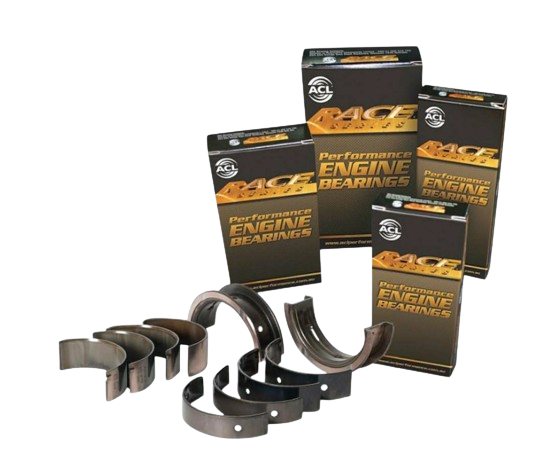
One popular example is the ACL Race Series HX bearing range. HX bearings are designed with approximately an extra 0.001 inch of oil clearance compared with the equivalent standard bearing size. This gives the engine builder another option when targeting a specific oil clearance without additional crankshaft machining.
HX bearings are commonly used in:
- high-performance street engines
- high-boost turbo engines
- drag racing engines
- high-RPM combinations
- engines using thicker oil viscosity
- builds where the standard clearance measures tighter than desired
For example, if a crankshaft and housing combination measures on the tight side using standard bearings, an ACL HX bearing may help bring the oil clearance into a more suitable range for the intended power level and operating temperature.
However, extra clearance is not automatically better. The oiling system, oil viscosity, intended RPM range and engine use still need to be considered as a complete package.
ACL Calico Coated Bearings
ACL Race Series bearings are also available in some applications with a Calico coated surface treatment. Coated bearings are designed to provide an additional protective layer on the bearing surface.
Benefits commonly associated with coated bearings include:
- additional protection during cold starts
- improved resistance to momentary oil film breakdown
- reduced risk of minor surface scuffing during transient load conditions
- additional protection during engine run-in
In high-load turbocharged engines, coated bearings can provide an extra layer of protection during short-term lubrication stress events. They are commonly used in serious street, drag and circuit engines.
One important point is that bearing coatings can slightly affect the final assembled oil clearance. The coating thickness is small, but in a precision engine build even a very small dimensional change matters.
Because of this, the final oil clearance should always be measured with the actual coated bearings being used in the engine. Clearance should never be assumed based on an uncoated version of the same bearing.
As with any bearing selection, coated bearings are not a substitute for proper machining, oil control or tuning. They are best viewed as an additional layer of protection within a correctly engineered engine package.
How Bearing Choice Affects Clearance
Performance bearings are often available in standard, extra clearance and undersize or oversize options depending on the engine family. This allows the engine builder to fine-tune the final clearance without grinding the crankshaft unnecessarily.
Common bearing considerations include:
- bearing material
- coated vs uncoated bearings
- standard vs extra-clearance shells
- crank journal size
- housing bore size
- intended oil viscosity
The best bearing is not simply the most expensive one. The best bearing is the one that gives the correct clearance and durability for the engine combination.
Should Clearances Be Tighter for Street Engines?
Generally, a street engine often runs tighter clearances than a full race engine because it needs stable hot idle oil pressure, good cold start behaviour, quiet operation and long service life.
However, a powerful street engine is not the same as a stock engine. A high-boost street Barra, JZ, RB or LS still creates serious bearing load. The clearance strategy needs to reflect that.
The key is balance. Too tight can reduce oil film margin. Too loose can hurt oil pressure and street manners.
Should Clearances Be Looser for Race Engines?
Race engines may use looser clearances, but that does not mean loose is automatically better.
A race engine with looser bearing clearances usually needs:
- the right oil viscosity
- enough oil pump capacity
- excellent sump control
- controlled oil temperature
- regular inspection and maintenance
Looser clearances without the right oiling system can create more problems than they solve.
Quick Comparison: Tight vs Loose Bearing Clearance
| Clearance Condition | Potential Benefit | Potential Risk |
|---|---|---|
| Tighter clearance | Higher oil pressure, quieter operation, good for controlled factory-style applications | Less oil film margin, more heat risk, less tolerance for high load or debris |
| Moderate performance clearance | Good balance for many street and performance engines | Still needs accurate measurement and correct oil selection |
| Looser clearance | More oil film room and flow potential in race-style applications | Lower oil pressure, more leakage, more demand on the oiling system |
Recommended Engine Builder Checklist
Before final assembly, a quality engine builder should check:
- main tunnel alignment
- main bearing clearance on every journal
- rod bearing clearance on every journal
- crankshaft journal diameter and taper
- crankshaft journal out-of-round
- rod big-end housing bore size
- bearing crush
- side clearance
- thrust clearance
- oil pump condition and capacity
- final oil viscosity recommendation
Where Spool Parts Fit Into the Picture
Spool Imports supplies performance engine components for serious street, drag, drift and circuit builds, including forged conrods, forged pistons, crankshafts, bearings, head studs and rotating assembly components for popular platforms such as Ford Barra, Toyota JZ, Nissan RB, GM LS and many more.
Quality parts are only one part of the result. The final machining, measuring and assembly process is what turns those parts into a reliable engine. Whether you are using Spool H-Beam conrods, Drag Pro conrods, X300 I-Beam conrods, forged pistons or a complete rotating assembly package, bearing clearance should always be checked as part of the build.
If you are planning a forged engine build and are unsure which parts suit your power goal, contact Spool Imports for advice on the right combination for your application.
Frequently Asked Questions
Is main bearing clearance the same as rod bearing clearance?
No. Main bearing clearance is measured between the crankshaft main journals and the main bearings in the block. Rod bearing clearance is measured between the crankshaft rod journals and the bearings in the connecting rods. They are related, but they perform different jobs.
Which is more important, main bearing clearance or rod bearing clearance?
Both are critical. Main bearing clearance affects crankshaft support and stability. Rod bearing clearance affects the oil film between the connecting rod and crank journal. A failure in either area can destroy the engine.
What happens if rod bearing clearance is too tight?
If rod bearing clearance is too tight, there may not be enough oil film between the crank journal and bearing. This can cause heat, bearing wipe, material transfer or bearing seizure, especially in a high-load performance engine.
What happens if main bearing clearance is too loose?
If main bearing clearance is too loose, the engine may lose hot oil pressure and crankshaft control. It can also increase oil leakage from the bearing area and place more demand on the oil pump.
Can I use Plastigage to check bearing clearance?
Plastigage can be used as a basic check, but it is not the preferred method for a serious performance engine build. A micrometer and dial bore gauge provide a more accurate measurement.
Do forged rods change bearing clearance?
Forged rods do not automatically create a specific clearance. Bearing clearance depends on the crank journal size, bearing shell thickness, rod big-end housing bore and fastener procedure. Always measure the final assembled clearance.
Does oil viscosity affect bearing clearance?
Oil viscosity does not physically change the clearance, but it affects how the engine behaves with that clearance. Thicker oil may suit some looser race-style clearances, while tighter clearances may require a different oil strategy. The oil and clearance should be matched.
Should boosted engines run looser bearing clearances?
Not always. Boosted engines need enough oil film strength to handle higher cylinder pressure, but the correct clearance depends on the engine platform, power level, oil system, RPM range, oil temperature and intended use.
Final Thoughts
Main bearing clearance and rod bearing clearance are two of the most important measurements in any engine build. They directly affect oil pressure, oil film strength, crankshaft stability, bearing temperature and long-term reliability.
The right clearance is not just a number copied from another build. It is the result of careful measuring, correct machining, the right bearing choice, suitable oil viscosity and a clear understanding of how the engine will be used.
For a mild street engine, the goal may be quiet operation and stable oil pressure. For a high-boost drag, drift or circuit engine, the goal may be maximum oil film strength and durability under extreme load. Either way, the engine needs to be measured properly.
If you are building a forged Barra, JZ, RB, LS, Subaru, Honda, Mitsubishi or other performance engine, Spool Imports can help with the right rods, pistons, bearings, crankshafts, studs and supporting components for your build.