If a new set of bearings gives the wrong oil clearance, stop and find out why before buying another size. The result comes from the crankshaft journal, the bearing shells and the housing they are clamped into. Changing bearings can correct a small size difference, but it cannot put a distorted rod or damaged crankshaft right.
The useful measurement is the clearance with the actual bearings fitted and the caps tightened correctly. Measure each journal and its matching assembled bearing, then compare the result with the specification for that engine and build. A number copied from another engine is not a substitute.
What are you measuring?
Oil clearance allows oil to pass between the crankshaft journal and the bearing. Too little clearance can lead to overheating and contact between the surfaces. Too much can increase oil leakage from the bearings and reduce hot oil pressure. The suitable clearance depends on the engine, its operating conditions and the oil being used.
For this check, subtract the journal diameter from the installed bearing's inside diameter, measured across its crown, at 90 degrees to the joint between the two halves. This is diametral clearance, not the gap on just one side of the journal.
Start with the crankshaft
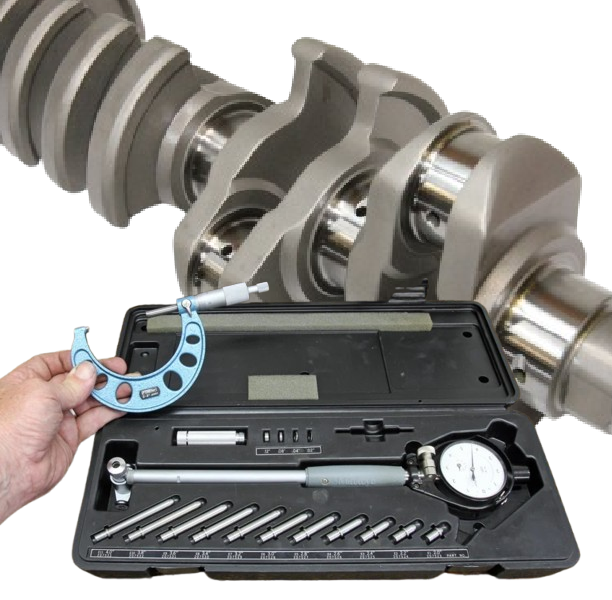
Use a suitable outside micrometer on clean journals. Measure at several positions along each journal and around its circumference. A journal can be the right size at one point but tapered or out of round elsewhere. Record those differences rather than averaging them into one reassuring number.
Keep the readings labelled by journal. If the crankshaft needs grinding, have the machine shop establish the repair size and suitable bearings before machining starts. Grinding removes material and makes a journal smaller; it cannot make one larger.
Measure with the bearings installed
Fit the correct shells into clean housings, keeping each cap in its original position and orientation. Use the intended fasteners, specified lubricant and tightening procedure. Where the rod manufacturer specifies bolt stretch, use that procedure and a stretch gauge. The cap must be clamped as it will be in service.
Use a dial bore gauge to measure the installed bearing at 90 degrees to the cap's joining faces. Avoid taking the clearance reading beside that joint: bearing shells are deliberately relieved there, so the reading will not represent the minimum clearance across the crown.
Subtract the matching journal diameter from that reading. Alternatively, a bore gauge correctly zeroed to the measured journal diameter can show the difference directly. Take care with the gauge's direction of movement and units.
For example, an installed bearing measuring 2.1025 inches around a 2.1000-inch journal gives 0.0025 inch clearance. That is an arithmetic example, not a recommended setting for your engine.
Use the engine builder's agreed target and the relevant engine and bearing specifications. A street rebuild and a competition engine may need different decisions about clearance, oil and operating temperature. There is no single main-bearing or conrod-bearing clearance that suits every build.
Where Plastigage helps
Plastigage is useful as a final assembled-clearance check. It does not replace measuring journal size and housing condition with precision tools.
Follow the instructions supplied with the exact product, including surface preparation and supporting the crankshaft so its weight does not distort the reading. Place the strip along the journal, parallel to the crankshaft axis, then fit and tighten the cap. Do not turn the crankshaft while the strip is being compressed.
Remove the cap carefully and compare the flattened strip with the packet scale along its length. Variation is a reason to investigate, not simply choose the reading you prefer. Remove the residue without scratching the journal or bearing. The Clevite Plastigage instruction sheet describes the procedure and available measuring ranges.
If the clearance is too tight or too loose
First repeat the measurement and confirm the part number, journal size, cap position and tightening procedure. Dirt behind a shell, an incorrect bearing size or an out-of-spec housing can all change the result. A machine shop can measure the empty housing when the cause is unclear.
For a sound, correctly sized assembly, a thinner-wall bearing provides more clearance; a thicker-wall bearing provides less. Avoid ordering from the word “oversize” alone. It can refer to a different dimension, including the bearing's outside diameter for a machined housing.
ACL HX-STD bearings provide a nominal 0.001 inch more oil clearance than the equivalent H-STD pair. That does not mean every engine needs HX. Select them when the measured assembly calls for the extra clearance. Where available, ACL H-001 or H-.025 bearings reduce clearance by a nominal 0.001 inch compared with H-STD. Confirm the exact size and availability for your engine.
A crankshaft ground to an undersize needs bearings intended for that smaller journal. Do not confuse a small clearance-adjustment size with a repair size for a reground crank. If machining is necessary, the machinist should match the journal dimensions to the selected bearings and required finished clearance.
Do not sand or polish the bearing surface to make the clearance larger. That damages the designed surface and can remove its thin overlay. Keep any selective mixing of shell grades within the bearing manufacturer's instructions rather than improvising a combination. ACL's clearance-control specification bulletin sets out its H-STD, HX-STD and adjustment-grade relationships.
Before final assembly
Record the final clearance for every journal and keep the measured shells with their locations. Recheck after changing a shell or machining a part. Once the measurements are accepted, clean the components and apply the specified assembly lubricant to the running surfaces before final assembly.
Spool supplies ACL Race Series bearings alongside its conrods and crankshafts. When asking us to help select a bearing size, provide the engine, bearing part number, measured journal diameter and the builder's required clearance. That makes the choice much more useful than simply asking for a “race” bearing. Contact Spool with your measurements if you need help identifying the available part.
Frequently asked questions
Will new bearings automatically give the correct clearance?
No. The result depends on the journal, bearing thickness, housing dimensions and how the caps are tightened. Measure the actual assembled combination.
Can grinding the crankshaft fix excessive clearance?
Grinding makes the journal smaller, so it does not reduce clearance with the same bearings. A repair requires a properly matched journal size and bearing set, specified by the machine shop.
Does HX mean the crankshaft has been ground undersize?
No. ACL HX-STD denotes extra oil clearance on a standard-size journal compared with the equivalent H-STD bearings. It is different from a repair-size bearing for a reground crankshaft.