
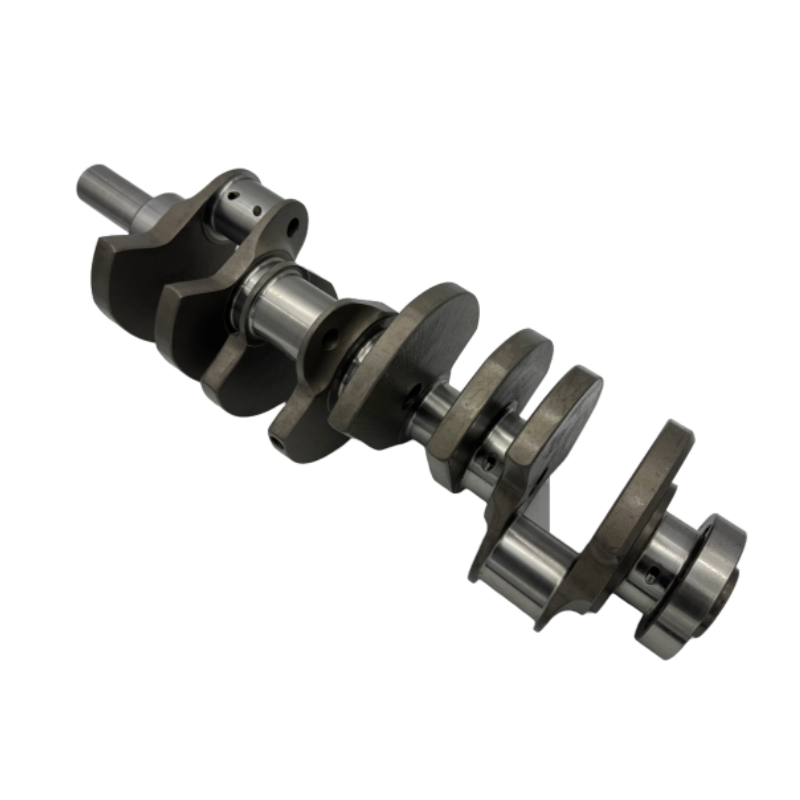
An LS crankshaft can be the right stroke and still be wrong for your engine. Before ordering, match it to the rods and pistons, the engine's crank-position signal, and the parts that attach at each end. Sorting those details now is easier than discovering a mismatch after the rotating assembly has been balanced.
Start with the combination you are actually building, not just the badge on the donor car. Swapped engines often contain parts from more than one LS application, so an engine code alone may not tell the whole story.
Choose the stroke with the rods and pistons
More stroke means the piston travels farther up and down the bore. At the top of its travel, half the crankshaft stroke, the rod length and the piston's compression height together determine where the crown sits relative to the block deck. Compression height is the distance from the centre of the piston pin to the crown reference surface.
That is why a longer-stroke crank is not simply a replacement for a standard crank while everything else stays the same. The piston and rod combination determines where the crown finishes relative to the deck. Get the machine shop involved before buying individual parts, particularly if the block has already been decked.
Our compression-height and deck-clearance guide explains the measurements behind that decision. For ordering, have the proposed stroke, rod length, piston part number and finished bore together, rather than choosing each in isolation.
The Spool full-counterweight LS crankshaft uses a 4.000-inch stroke and 4340 billet steel. It requires block clearancing in a stock cylinder block. That machining is part of planning this combination, not a fault to work around during final assembly. The actual crank, rods and block need a trial assembly to establish where clearance is required.
Match 24x or 58x to the engine management
The reluctor wheel is the toothed wheel the crank-position sensor reads. Its signal tells the engine management where the crankshaft is in its rotation. A 24x wheel and a 58x wheel provide different signals; selecting the wrong one can leave otherwise compatible mechanical parts with an engine that will not run correctly.
Match the wheel to the crank sensor and controller being used. Do not choose it only from the car's year, especially on an engine conversion. The cam-position signal also needs to suit the engine-management arrangement, so pass on the ECU and cam-signal details if the build mixes generations.
The Spool crank is listed without a reluctor wheel as standard, with no-wheel, genuine GM 24-tooth and genuine GM 58-tooth ordering options. Resolve the required option before ordering, and establish who is fitting it. Supplying a wheel and having it correctly installed are different jobs. Installation and indexing should be handled with the correct procedure and equipment, not by guessing its position.
The rear flange has to suit the transmission parts
Do not assume every LS flywheel or flexplate fits every LS crank. There are different bolt patterns within the family. The flange position and the rest of the transmission installation matter too, not just whether the bolt holes line up.
For a manual, give the supplier the gearbox, flywheel and clutch details, including the intended pilot-bearing arrangement. For an automatic, include the flexplate and converter combination. A mismatched stack can affect engagement or alignment even when the parts appear to bolt together.
Keep any existing spacer or adapter part numbers with that information. They may be essential to the current combination, or they may no longer be appropriate with the replacement crank. Do not carry them across simply because they came off the old engine.
Check what fits on the front as well
The crank snout carries the front-drive components. Its length and the oiling arrangement are not identical across all LS applications. Some factory dry-sump combinations use a longer snout to accommodate their oil-pump arrangement.
A crank chosen for a wet-sump build therefore needs to suit the intended oil pump, timing drive and balancer arrangement. Treat a change between factory dry-sump and wet-sump components as a specific compatibility question, not a generic LS interchange. The Chevrolet Performance parts catalogue documents crankshaft, reluctor and oil-system differences; use the exact part specification for the combination being ordered.
Matching parts still need measuring and balancing
A standard journal description does not remove the need to measure the crank and establish bearing clearances. The builder also needs to assess the bearing's compatibility with the radius where each journal meets the crank cheek. An unsuitable bearing edge can interfere there even when the nominal journal diameter is correct.
Have the complete rotating assembly balanced for its actual components. The piston, pin, rings, rod and bearing weights affect the balance work. Changing the piston or rod specification after balancing can mean doing that work again.
Before final assembly, the builder should also verify crankshaft end float and rotating clearance with the chosen parts. There is no single grinding depth, bearing clearance or balance specification that can be safely applied to every LS stroker build.
What to send with your enquiry
Send the block identification, finished or planned bore, desired stroke, rod and piston part numbers, ECU and reluctor requirements, and the transmission details. Add the oil-pump and balancer arrangement if it differs from the original engine. If a part is already on the bench, its label and clear photographs are more useful than a guessed application.
Contact Spool with those details before committing to a crank on stroke alone. It gives us a useful starting point for identifying the right parts and separating what can be supplied from what your engine builder still needs to measure or machine.
Common LS crankshaft questions
Can I keep my existing rods and pistons with a longer-stroke crank?
Not without checking the complete combination. The stroke, rod length, piston compression height and block deck height determine where the piston finishes. Rotating clearance also needs checking with the actual parts.
Does the Spool 4-inch full-counterweight crank include a reluctor wheel?
Not as standard. The listing offers no-wheel, 24-tooth and 58-tooth options. Select the option that suits the engine management and establish the installation arrangements before ordering.
Will any LS flywheel fit an LS crankshaft?
No. Bolt patterns and transmission arrangements differ. Match the crank flange, flywheel or flexplate, and gearbox or converter combination rather than relying on the LS name.

