
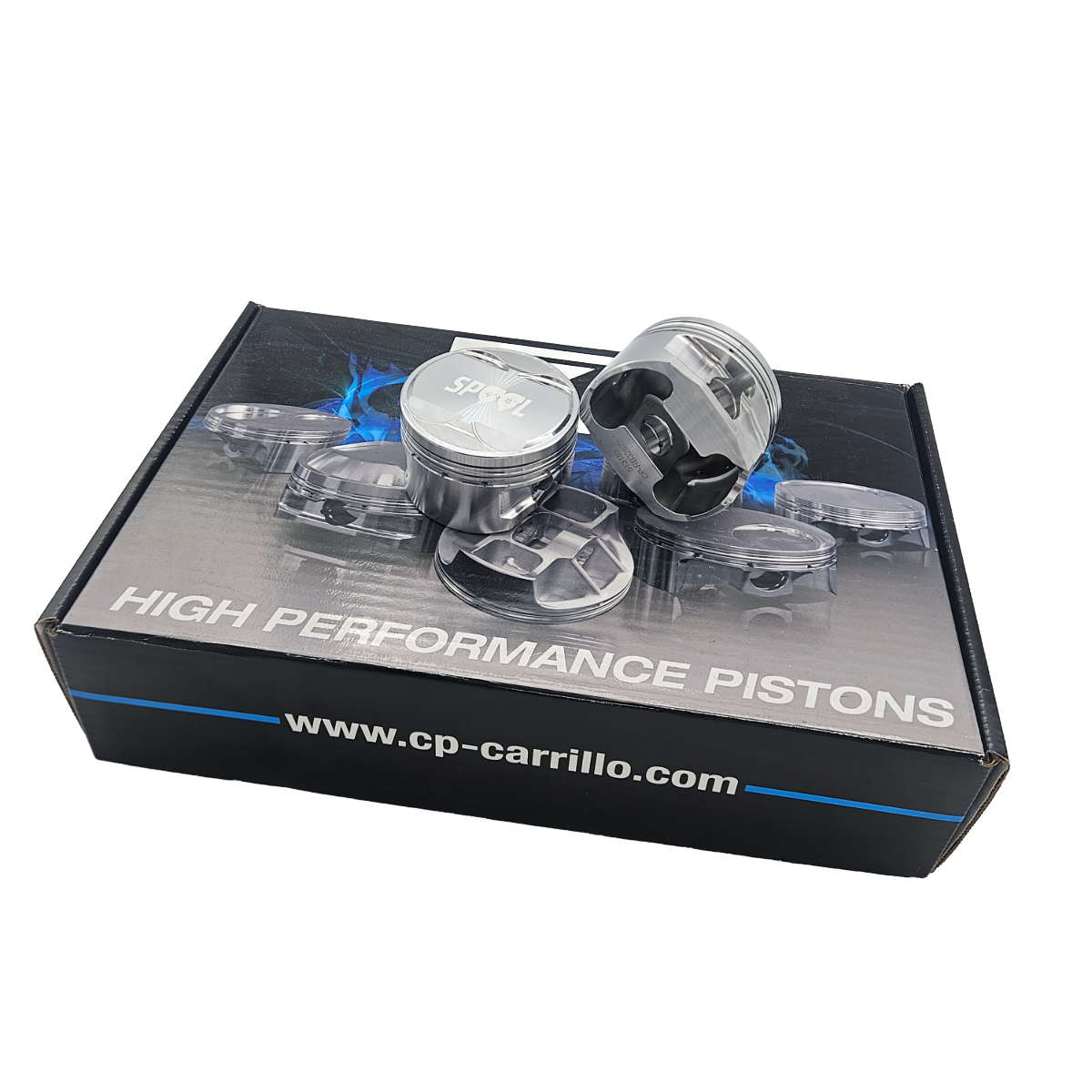
A camshaft and a set of forged pistons can both be listed for your engine and still not work together. Before ordering, check that the piston pockets suit the valves and heads you plan to use. Then have your builder measure the clearance with the actual parts and cam timing before the engine goes together for good.
Don't decide from maximum lift alone. The piston is well down the bore by the time the intake valve reaches full lift in a typical four-stroke engine. The tight spot is usually around the top of the exhaust stroke, where the piston is high in the bore and the exhaust valve is still closing as the intake valve starts to open. How far the valves are open there matters more than the biggest lift figure on the box.
Read the cam card before choosing the piston
Two cams can have similar peak lift but leave the valves at different positions around the top of the stroke. That's why the cam part number and the intended installed timing are more useful to your piston supplier than a description like “Stage 2”. For example, the Kelford 193-B cam card for the Toyota 4A-GE 16V lists lift at top dead centre separately from net valve lift. That entry gives you a useful starting point; it is not a measurement of your minimum clearance.
Installing the cam “dot to dot” lines up the timing marks. Degreeing it means measuring where the valve events actually occur in relation to the crankshaft and checking them against the cam card. A different installed position can give one valve more room around overlap while taking room away from the other. If the engine retains variable cam timing, the builder needs to check the usable timing range, not just the parked position.
The valve needs room at the side of the pocket too
A valve relief is the recess in the piston crown that gives a valve room to open. It needs to be deep enough, but the valve head also needs room around the edge. Different heads, larger valves or a change in valve angle can put the edge of the valve into the side of a pocket that looks plenty deep. CP's DH7127 piston drawing is a useful example of how a manufacturer specifies pocket depth, angle and diameter separately. Its dimensions apply to that piston only.
Head or block machining and a different compressed gasket thickness can bring the valves and pistons closer. Stroke, rod length and piston compression height can also change where the crown sits. Our guide to piston compression height and deck clearance explains that part of the build. A good deck reading still doesn't tell you whether a moving valve clears the crown.
What the trial assembly should tell you
The builder needs the intended head, valves, piston, valvetrain and gasket thickness represented in the mock-up, with cam timing and lash or hydraulic checking setup set for the application. The crank is turned by hand, without forcing it through resistance. A dial indicator with light checking springs can measure how much farther the valve can move before it touches the piston at different crank positions. A clay impression can also show where the valve sits in the pocket and whether the edge is close. Look for the tightest point on each valve, not just a reading at top dead centre.
A hand-turned engine that doesn't hit isn't proof of enough clearance when running. The engine builder should agree a clearance target with the relevant manufacturers for the exact components and intended use. A modified head or a combination that falls short may need a different piston or cam. If pocket machining is an option, have the builder verify the remaining crown thickness and ring-land position with the piston manufacturer before cutting.
What to send Spool before ordering
Send the exact engine and head casting, valve diameters, cam part number and card, and the intended timing setup, including whether variable timing is retained. Include the piston part number or drawing if you already have one, plus the finished deck position, gasket thickness and any known machining. That gives us a much better basis for matching catalogue camshafts and pistons, or working through our custom CP-Carrillo piston service when a catalogue pocket doesn't suit the build. The trial assembly is still the final check.
Frequently asked questions
Does a higher-lift cam always reduce piston-to-valve clearance?
No. What matters is how far each valve opens when the piston is close, which depends on the lobe profile and installed timing. Peak lift occurs at a different point in the cycle.
Do forged pistons with valve reliefs automatically clear aftermarket cams?
No. The position, angle, depth and diameter of each relief must suit the actual head and valves. The builder still needs to measure the assembled combination with the intended timing.
Can I check piston-to-valve clearance only at top dead centre?
No. The minimum can occur before or after top dead centre around overlap. Measure through the relevant crank positions and account for any variable cam timing that will be used.

